Your competitor just got named in a Gemini answer. A prospect asked "which project management tool is best for a 20-person agency?" and your competitor's name appeared. Yours didn't. That single Gemini recommendation makes the prospect 389% more likely to Google that brand directly and 117% more likely to visit its site. You lost that buyer before they ever touched a search results page.
Understanding how Gemini recommends businesses isn't a technical curiosity. It's a commercial priority. AI-referred traffic to websites grew roughly 10x over the past 12 months, and that curve isn't flattening. If Gemini doesn't recommend you, a growing share of your market simply never finds you.
How does Gemini decide who to recommend?
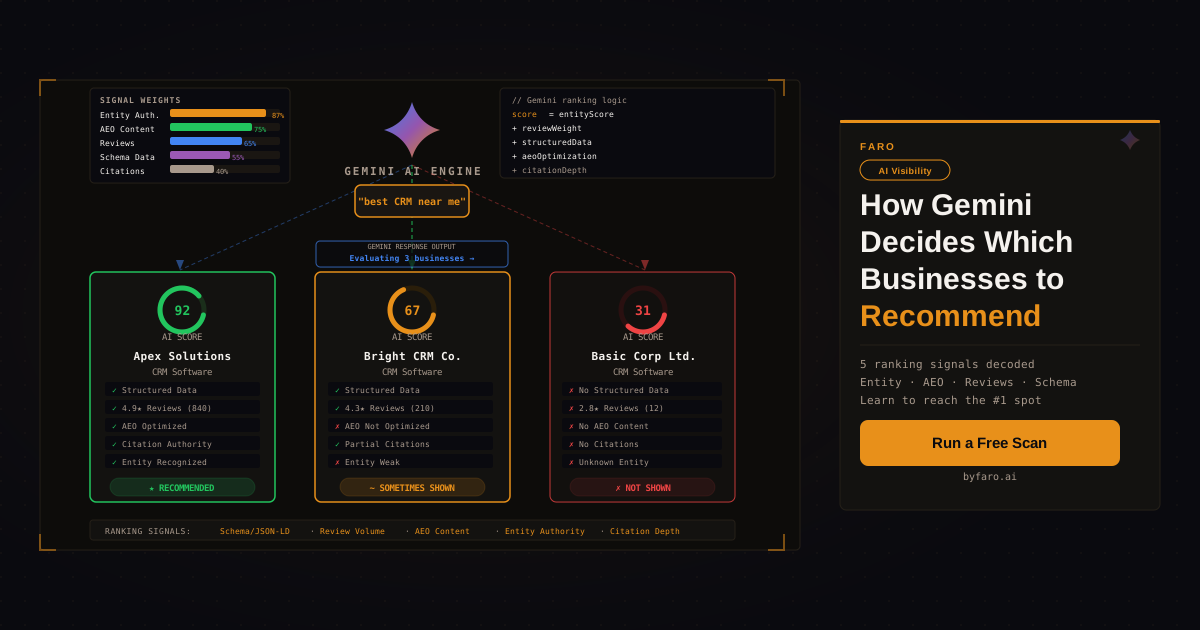
Gemini doesn't crawl and rank pages the way Google's traditional index does. It synthesizes information from multiple sources at training time and at inference time, then selects businesses it can confidently describe, verify, and attribute. Confidence matters most. Gemini recommends businesses it can say something specific and corroborated about. Vague, thin, or inconsistent information gets filtered out, not surfaced. Claude runs a similar confidence check but weighs different corroboration signals, covered in how Claude evaluates business websites for recommendations.
Three broad signal categories drive this selection process:
- Entity clarity: Gemini needs to understand what your business is, who it serves, and what it does, without inference. If your homepage describes you as "a next-generation solutions provider," Gemini has nothing to work with.
- Structured data: Schema markup,
llms.txtfiles, and machine-readable metadata give Gemini explicit facts rather than forcing it to guess from prose. - Third-party corroboration: Reviews, citations, mentions in trade publications, and forum discussions all function as independent verification. If only your own site describes you, Gemini treats that as weak evidence.
Why is traditional SEO no longer enough?
Google AI Overviews reduce organic click-through rate by 58% on average. That statistic alone should change how you think about search strategy. Ranking on page one no longer guarantees traffic if the AI answer above your listing already resolved the user's question.
Traditional SEO optimizes for crawl, index, and rank. AI recommendation optimization targets a different outcome: being selected as a confident answer. The two disciplines share some overlap but diverge sharply on structured data, entity consistency, and off-site corroboration. A site can rank in position one for a keyword and still be invisible in Gemini's outputs if its structured data is absent or contradictory.
Marketers who treat AI visibility as a future problem are already losing ground to competitors who treat it as a present one.
Not sure where your site stands? Run a free AI visibility check and get a scored breakdown of the signals Gemini and other AI assistants actually check.
What structured signals does Gemini prioritize?
Based on how large language models process web content, several technical signals consistently increase the probability of inclusion in AI-generated recommendations.
The six signals that matter most
| Signal | What it tells Gemini | Common failure mode |
|---|---|---|
| Schema markup (Organization, Product, Service) | Who you are, what you offer, how to contact you | Missing entirely or only on homepage |
| llms.txt file | A machine-readable summary of your site's content and permissions for AI crawlers | Not present on most sites as of mid-2026 |
| NAP consistency (Name, Address, Phone) | Verification that the business is real and stable | Mismatched data across directories and site |
| Pricing transparency | Allows AI to answer "how much does X cost?" confidently | "Contact us for pricing" blocks AI recommendation |
| Third-party citations | Independent corroboration of claims you make | Only self-published content references the brand |
| robots.txt configuration | Whether AI crawlers are permitted to read your content | AI bots accidentally blocked by legacy rules |
Each of these signals is auditable. Most sites fail at least three of them without realizing it. The AI Schema Creator generates the correct structured markup for your business type in minutes, removing one of the most common gaps. For the entity-level facts Gemini keeps checking for consistency, the OKF Generator puts your business description, services, and audience into one machine-readable file that says the same thing everywhere.
How does third-party corroboration work in practice?
Gemini doesn't trust a business purely on what that business says about itself. It looks for pattern-matching across independent sources: review platforms, industry directories, editorial coverage, and user-generated content. When multiple unaffiliated sources describe you consistently, Gemini's confidence in recommending you increases.
This dynamic carries risk. Researchers demonstrated that a single 13-word Reddit comment can poison what ChatGPT's deep-research agents report back to users. The same vulnerability applies to Gemini and other AI assistants. Negative or misleading third-party content can suppress or distort how Gemini presents your business. Monitoring what's being said about you in AI-indexed spaces isn't optional anymore.
Actively build a corroboration footprint. Encourage customers to leave detailed reviews that mention your specific services and use cases. Get cited in trade publications. Participate in forums where your buyers ask questions. These activities have always mattered for SEO, but they now carry additional weight because AI models treat them as independent verification.
What does pricing transparency have to do with AI recommendations?
Quite a lot. One of the most common prompts users send to Gemini is a comparison query: "What's the best [tool/service/agency] for [use case] and how much does it cost?" If your pricing page says "contact us for a quote," Gemini cannot answer the cost portion of that question with your business included. It will recommend the competitor who published clear pricing instead.
When AI recommends a brand, buyers are 182% more likely to search for it and 117% more likely to visit its site. Hidden pricing isn't just a conversion barrier on your own site. It's a disqualification signal for AI recommendation engines that are actively sourcing answers to cost questions.
You don't have to publish exact figures. Starting price ranges, pricing tiers by company size, or "from X per month" language all give Gemini something to work with. The Pricing Clarity Auditor checks whether your current pricing presentation meets the bar AI assistants require to include you in cost-related recommendations.
What should you actually do this week?
Theory is useful. A fix list is more useful. Here's the prioritized action sequence we recommend for most marketers and agency owners starting from scratch on AI visibility:
- Audit your robots.txt file. Confirm you aren't accidentally blocking AI crawlers like GPTBot, GoogleOther, or Gemini's own agents. One legacy disallow rule can make your entire site invisible to AI systems.
- Add or repair Schema markup. At minimum, implement Organization, Service, and FAQ schema on your core pages. These give Gemini explicit facts to cite.
- Create an llms.txt file. This relatively new standard lets you tell AI crawlers exactly what your site contains and what they're allowed to use. Most of your competitors haven't done this yet.
- Fix pricing transparency. Review every product and service page. Replace "contact us" placeholders with at least a range or tier structure.
- Build your corroboration footprint. Identify three to five review platforms or directories relevant to your category and ensure your listings are complete, consistent, and recently updated.
- Monitor AI-indexed mentions. Track what third-party content about your brand exists where AI models can read it. Address inaccurate or hostile content proactively.
This isn't a one-time project. Gemini's training data refreshes, its retrieval methods evolve, and your competitors are working on the same problem. Treat AI visibility as an ongoing channel, not a checklist to complete once.
In short
Gemini business recommendations follow a logic that rewards structured, consistent, and independently corroborated information. Sites that give AI models clear facts to work with get recommended; sites that don't get filtered out, regardless of their traditional search rankings. The cost of inaction compounds quickly: AI-referred traffic grew 10x in a year, AI Overviews are already cutting organic CTR by 58%, and a single first recommendation makes a brand 389% more likely to be searched directly. The fix list is concrete and most of it is executable without a developer. Start with an audit, close the structured data gaps, publish pricing clarity, and build the third-party record that gives Gemini the confidence to name you first.
Get a scored breakdown of where your site stands across all seven AI visibility categories. Run your free AI Visibility Checker and see exactly which signals are costing you Gemini recommendations today.
Frequently Asked Questions
Does Gemini use Google Search rankings to decide which businesses to recommend?
Not directly. Gemini synthesizes information from its training data and, where applicable, real-time retrieval, but the selection logic prioritizes entity clarity, structured data, and third-party corroboration rather than organic ranking position. A site can rank in position one for a keyword and still be absent from Gemini's recommendations if it lacks the signals AI models rely on.
How important is Schema markup for appearing in Gemini answers?
Very important. Schema markup gives Gemini explicit, machine-readable facts about your business rather than forcing it to extract meaning from prose. Organization, Service, Product, and FAQ schema are the highest-priority types for most B2B businesses. Missing schema is one of the most common and most correctable gaps in AI visibility audits.
What is an llms.txt file and do I need one?
An llms.txt file is a plain-text document at your domain root that tells AI crawlers what your site contains and what they are permitted to use. It's analogous to robots.txt but designed specifically for large language model agents. Most sites don't have one yet, which means they're leaving a direct communication channel with AI systems unused. You can generate one with Faro's llms.txt Generator.
Can negative reviews or forum posts hurt my Gemini recommendations?
Yes. AI models treat third-party content as independent verification of claims about a business. Researchers have shown that even a single short piece of hostile or misleading user-generated content can alter what AI deep-research agents report. Monitoring and actively building positive corroboration is the best defense against this risk.
How often should I re-audit my AI visibility signals?
Quarterly is a reasonable minimum for most businesses. Gemini's underlying model updates, new AI crawlers emerge, and competitors close their own gaps continuously. A quarterly audit catches signal drift before it compounds into sustained recommendation loss. Faro's Agency tier includes continuous AEO Citation Monitoring for teams that need real-time visibility into how AI systems are citing their brands.