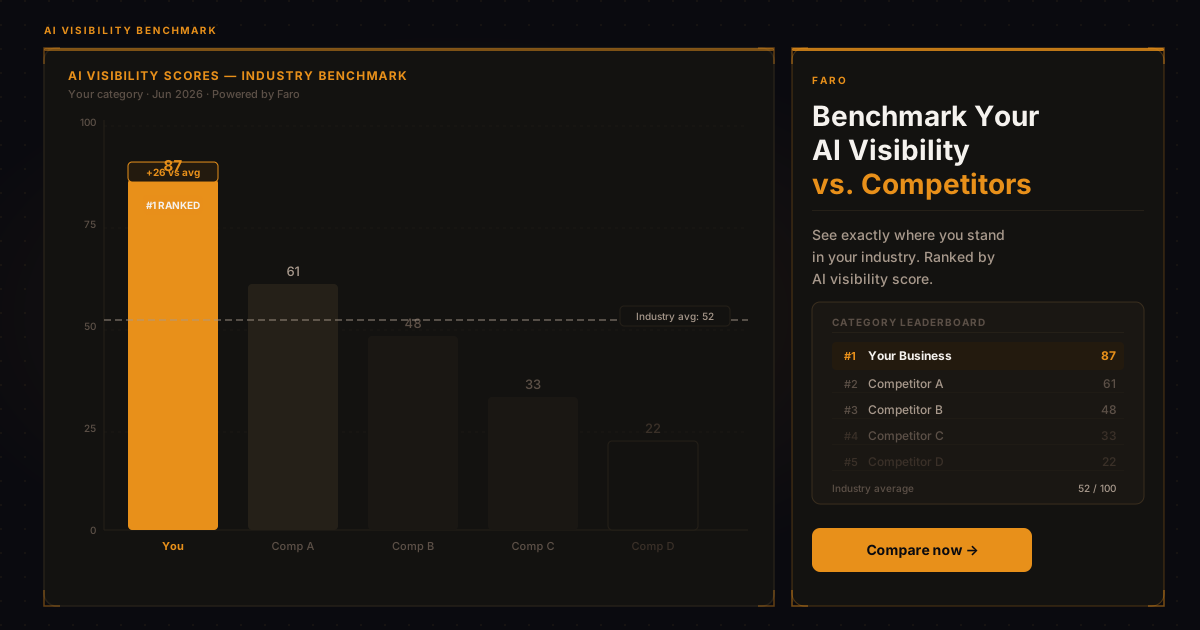
Your AI visibility score on its own tells you almost nothing. It tells you where you are. It doesn't tell you whether that's good. If your whole category is asleep at the wheel, a mediocre score still puts you ahead. But if your top three competitors have already published llms.txt files, structured data, and open API endpoints, then nailing one check doesn't close the gap. It barely dents it.
Benchmarking against competitors is fast becoming standard practice for growth teams and agencies juggling multiple brands. Here's how to actually do it, what to measure, and what to do once the numbers are in front of you. It's also become a fixture on the list of things marketing leaders are expected to track; see our breakdown of AI visibility for CMOs for where this fits into the broader reporting picture.
Key takeaways
- Your AI visibility score only means something next to your competitors' scores, because AI models recommend businesses relative to everyone else in your category.
- A complete benchmark covers 4 dimensions: technical signals, AI mention rate, sentiment quality, and entity strength.
- Mention rate is mentions divided by queries times models, measured on 5 to 10 category queries across ChatGPT, Claude, Perplexity, and Gemini.
- Technical gaps such as blocked crawlers and missing JSON-LD schema are the fastest to close, often in 1 or 2 days.
- Benchmark quarterly, or monthly if your category is growing fast or a major competitor is investing in AI visibility.
Why does benchmarking matter more than your absolute score?
AI models don't recommend businesses in a vacuum. They recommend you relative to everyone else in your category. When someone asks “what are the best tools for project management?”, the model builds a list from what it knows about the whole field. The names that surface are the ones with the strongest mix of training-data presence, structured signals, and entity verification, measured against every other business competing for the same slot.
And in the short to medium term, this is a zero-sum game. If a model returns five recommendations, every new entrant that earns a spot knocks an existing one out. So your goal isn't just a better absolute score. It's to be more legible to AI than the businesses sitting next to you on that list.
What should you benchmark against competitors?
A complete competitive AI visibility benchmark covers 4 dimensions: technical signals, AI mention rate, sentiment quality, and entity strength. Technical signals come from scanning each competitor's site. Mention rate and sentiment come from running the same category queries across ChatGPT, Claude, Perplexity, and Gemini. Entity strength shows up in Wikidata entries, LinkedIn and Crunchbase profiles, and Google Knowledge Panels.
Faro's own scans point the same way: of the 2,442 sites in the Faro Registry with a result for this check (scanned August 2026 to October 2026), 33% have sameAs links to Wikidata, LinkedIn or Crunchbase. The registry is the set of sites Faro has scanned, not a random sample of the web. So a competitor with these links already has an entity signal that most of the scanned sites lack.
1. Technical signals
These are measurable by scanning each competitor's site. The key signals to check:
- AI crawler permissions (robots.txt): are GPTBot, ClaudeBot, PerplexityBot allowed or blocked?
- llms.txt: does it exist, and how detailed is it? (The spec lives at llmstxt.org if you want to see what a good one looks like.)
- JSON-LD schema: is there Organization or Product schema? What fields are populated?
- sameAs links: how many external entity profiles are linked?
- agents.json: does it exist?
- Sitemap: is it published and referenced from robots.txt?
- Content-type headers: are they correctly configured?
These signals are publicly visible and can be scanned for any domain using Faro's AI Visibility Checker. Run your competitors through the same scan you run on yourself and compare scores directly.
A worked example, because a score means more with a real site attached. We ran the scan on get3dprinter.com, a small WordPress site that compares 3D printers for people about to buy one. It scored 60 out of 100. The shape of that result is the one you will see on most content and affiliate sites: crawler permissions (83%), structured data (81%) and heading structure (88%) were fine, because WordPress plus a decent theme gets you most of the way for free. Where it fell over was pricing transparency (33%: no machine-readable prices for the products it compares), trust signals (46%: no about page, no terms) and agent infrastructure (12%: nothing an agent could actually act on). Put that row next to a competitor's in the matrix and the gap stops being abstract. Any shopping agent working through a 3D printer buyer's guide will hit the same three holes across most of the category, which is exactly why they are cheap wins. The ecommerce readiness page walks through the product-level fixes.
2. AI mention rate
The mention rate is the percentage of AI model queries in your category where a given business appears. It's the most direct measure of AI visibility and the one that most closely maps to business impact.
To benchmark mention rates, you need to run the same set of category queries across AI models for both your business and your competitors. A standard benchmark would include queries like:
- “What are the best tools for [category]?”
- “Recommend a [category] solution for [persona].”
- “Compare the leading [category] platforms.”
- “Which companies offer [specific feature or capability]?”
Run each query across ChatGPT, Claude, Perplexity, and Gemini. Record whether each competitor appears in each response, and what position they appear in. This gives you a cross-model mention rate and a position distribution for each competitor.
Faro's Competitor Intelligence tooling does this automatically. You set your business and up to two competitors, and it runs the queries across all four models and hands back a share-of-voice comparison. No spreadsheet wrangling required.
3. Sentiment quality
Not all mentions are equal. A competitor that appears in AI responses but is described as “expensive and complicated” is effectively getting negative advertising. Benchmark not just whether competitors are mentioned, but how they're described.
When reviewing AI responses, look for:
- How is each competitor positioned (leader, alternative, budget option, enterprise choice)?
- What features or strengths does the AI attribute to each?
- Are there consistent negative qualifications (e.g., “though it can be pricey”, “steep learning curve”)?
Sentiment benchmarking reveals opportunities: if a competitor is frequently mentioned but with consistent negative qualifiers, and you don't have those qualifiers, you can emphasize the contrast in your own content and schema.
4. Entity strength
Entity strength measures how well-established a business is as a verified entity across the web. Indicators include:
- Wikidata entry existence and completeness
- LinkedIn company page with accurate data
- Crunchbase profile
- Number of sameAs links in schema
- Mentions in industry publications with links
- Google Knowledge Panel presence
This one's harder to put a number on. But you can do a quick qualitative audit: search each competitor's brand name in Google, then look at the Knowledge Panel, the Wikidata entry, and the general quality of third-party coverage. Take a B2B HR software company sizing itself up against Rippling and Gusto. Both of those incumbents have rich Knowledge Panels, complete Wikidata entries, and years of press. The smaller player almost certainly doesn't, and that gap is exactly the kind of thing a benchmark surfaces in black and white.
Run a competitive scan now
Faro's AI Visibility Checker lets you scan any domain and compare technical signals side by side. Scan yourself and your top three competitors to see where the gaps are.
Building a Competitive Benchmark Report
A practical competitive benchmark for AI visibility has four components: a technical signal matrix, a mention rate comparison, a sentiment summary, and a priority action list.
Technical signal matrix
Create a table with competitors as columns and the key technical signals as rows. Mark each as Pass, Partial, or Fail. This gives an immediate visual read of where each competitor stands and where you have gaps or advantages.
Example columns: Your Brand, Competitor A, Competitor B, Competitor C. Example rows: AI crawlers allowed, llms.txt published, Organization schema, Product schema, sameAs links, agents.json, sitemap. Each cell is a simple status.
Mention rate comparison
Run five to ten representative category queries across four AI models. For each query, record which businesses appear. Calculate a mention rate for each business as mentions divided by total possible mentions (queries times models). Express as a percentage.
A mention rate of 40% means a business appeared in 40% of all query/model combinations tested. If your rate is 25% and your top competitor is at 60%, that's a 35-point gap to close.
Sentiment summary
For each competitor that appears in AI responses, note the most common descriptors and qualifiers used. Look for patterns across models. If three of four models describe a competitor as “the enterprise option”, that's their de facto AI positioning, regardless of how they market themselves. If they're consistently described as “complex to set up,” that's a vulnerability you can address in your own positioning.
Priority action list
The output of a competitive benchmark isn't a score. It's a prioritized list of actions. Good actions are those that (a) close a gap where a competitor has an advantage you lack, or (b) extend a lead you already have. The signal matrix and mention rate comparison together identify both.
How often should you benchmark your AI visibility?
For most businesses, a quarterly competitive benchmark is appropriate. AI model knowledge updates on roughly 3 to 6 month cycles for foundational training data, and market conditions in most categories don't shift faster than that.
Exception: if your category is rapidly growing or you have a major competitor that is actively investing in AI visibility, monthly benchmarking is warranted. The first mover advantage in AI recommendation visibility is real, and the gap between early movers and laggards compounds quickly.
For agencies managing multiple clients in competitive categories, Faro's continuous tracking watches mention rates and alerts you when something shifts, which replaces the manual quarterly check entirely. You can see which tier covers competitor tracking on the pricing page. To see where you land against everyone else in your category at a glance, rather than benchmarking competitors one at a time, Faro's guide to the Vertical AI Leaderboard explains how the ranked view works. If you're weighing that kind of continuous tracking against other AI-visibility monitoring platforms, this side-by-side comparison covers where the approaches actually diverge.
What should you do with your benchmark results?
Your benchmark results tell you which kind of gap to close first. Technical gaps, such as blocked crawlers or missing JSON-LD schema, take 1 or 2 days to fix. A mention rate gap despite good technical signals points to a training data gap, which takes longer. Weaker sentiment means fixing the underlying issue behind the negative qualifiers.
If you're behind on technical signals
Technical gaps are the fastest to close. Unblocking crawlers, publishing llms.txt, and adding JSON-LD schema can be done in a day or two, and they land immediately on models with live retrieval. Do these before anything else. Honestly, the fact that they're this cheap to fix (which, in most categories, is still pretty rare) is why a laggard can leapfrog a slow incumbent in a single afternoon.
If you're behind on mention rate despite good technical signals
This suggests a training data gap. Your competitors have more historical presence in the data these models were trained on. The fixes here are longer-term: consistent publishing, earning press coverage and citations, appearing in industry roundups and comparisons, and building third-party content that references you alongside competitors in your category.
If your sentiment is weaker than competitors
Sentiment in AI responses correlates with how your business is described in the sources those models were trained on. If you have consistent negative qualifiers, look at where those qualifiers come from: review sites, comparison posts, forum discussions. Addressing the underlying issue (pricing, complexity, support) is the root fix. In the shorter term, creating authoritative content that provides balanced, accurate descriptions of your product can shift the signal over time.
The Benchmark as a Business Case
For agencies, this is one of the easiest retainers to sell. The format is already familiar, since it mirrors the competitive SEO audits agencies have presented for years. The data is objective. And the output is something a client can act on. Show someone that their competitor sits at a 45% mention rate while they're stuck at 15%, and they get it instantly, long before anyone has to explain what AEO stands for.
In Short
An AI visibility score only tells you half the story. The competitive benchmark tells you the other half: whether your score is good enough to beat the businesses you compete with for AI model recommendations. Run technical signal scans on your top competitors, measure mention rates across AI models, and track sentiment quality. The output is a concrete set of actions prioritized by competitive impact, not just absolute score improvement.
Start by scanning your competitors with Faro's AI Visibility Checker. Then compare your technical signals side by side and rank your gaps by competitive impact.
Frequently Asked Questions
Is it ethical to scan competitors' websites?
Scanning publicly accessible signals on competitors' websites (robots.txt, structured data, publicly declared files like llms.txt) is standard competitive intelligence, no different from manually reviewing a competitor's website. The signals we're examining are designed to be publicly accessible. Faro's scan does not access protected or non-public content.
How accurate are AI mention rate benchmarks?
AI model responses have variance: the same query can produce different results on different runs, especially on models with live retrieval. A reliable benchmark requires running each query multiple times and averaging results. Faro's AEO Citation Monitor runs each query three times per model to account for variance and reports a stabilized mention rate.
Can a small business compete in AI recommendation visibility against large incumbents?
Yes, especially in niche categories. AI models tend to surface the most authoritative sources for a specific query, not just the largest brands overall. A small specialist in a well-defined niche with excellent structured data and a strong llms.txt can outperform a large generalist on queries where the niche is the focus. The niche specificity is the competitive advantage.