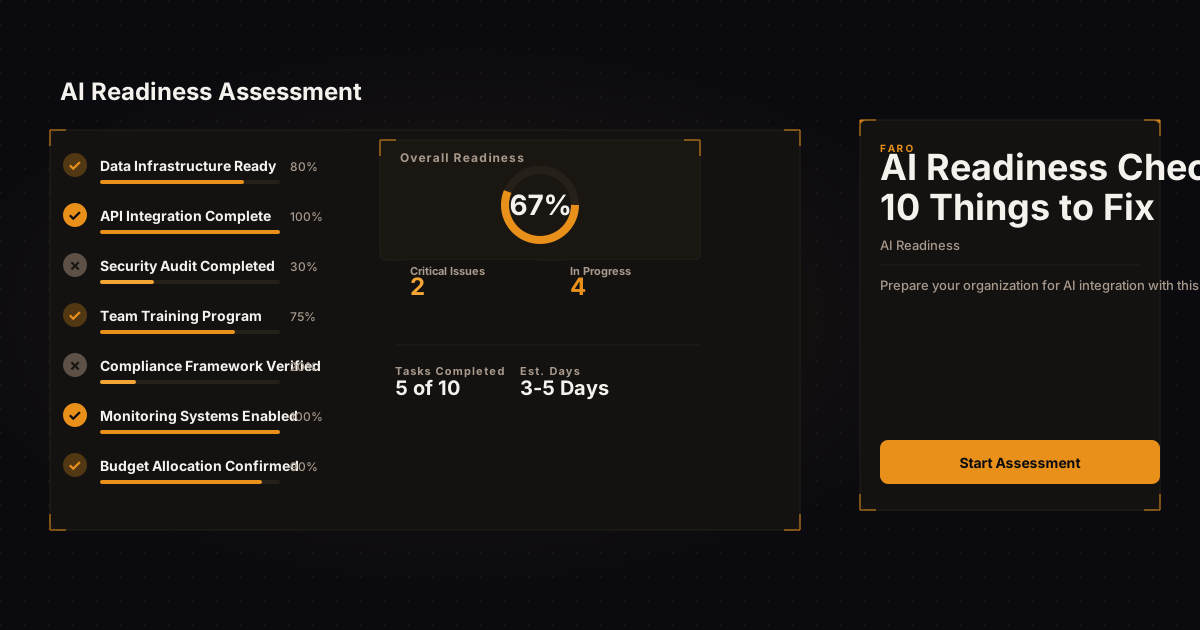
Your organic click-through rate just dropped. Not because your rankings moved, but because a Google AI Overview answered the question before anyone clicked. According to Ahrefs, AI Overviews reduce organic CTR by 58% on average. At the same time, AI-referred traffic to websites grew roughly 10x over the past 12 months. The implication stings: the channel that used to send you traffic is now absorbing it, while a new channel, AI referral, grows fast and rewards only brands that prepared for it. This AI visibility checklist gives you ten specific things to fix before next week. Each one moves you from invisible to citable.
Why does AI visibility matter more right now than it did six months ago?
AI agents are now the first point of contact for a significant share of commercial research. When an AI recommends your brand first, the downstream effect is large. Industry research published in 2026 found that brands recommended first by an AI assistant are 389% more likely to be Googled directly afterward, and that when AI recommends a brand, buyers are 182% more likely to search for it and 117% more likely to visit its site. That gap separates brands that show up in AI outputs from brands that don't. If your site isn't structured for AI consumption today, you're handing that compounding advantage to a competitor.
What does an AI visibility checklist actually cover?
Readiness spans technical access, structured data, content clarity, and reputation signals. The ten items below map to those four dimensions. Work through them in order. Each one compounds the next.
The 10-item checklist at a glance
| # | Item | Dimension | Time to fix | Cost of skipping |
|---|---|---|---|---|
| 1 | Audit your robots.txt for AI crawler blocks | Technical access | 30 minutes | AI agents cannot index your content at all |
| 2 | Publish an llms.txt file | Technical access | 1 hour | Agents guess at your content structure instead of reading it |
| 3 | Add Organization schema to your homepage | Structured data | 45 minutes | AI cannot verify your brand identity or category |
| 4 | Add Product or Service schema to key pages | Structured data | 1–2 hours | Competitors with schema get cited; you do not |
| 5 | Clarify your pricing page | Content clarity | 2 hours | AI omits you from comparisons because it cannot parse your offer |
| 6 | Write a clear, citable "About" paragraph | Content clarity | 1 hour | AI paraphrases you inaccurately or skips you entirely |
| 7 | Audit third-party mentions for prompt injection risk | Reputation signals | 2 hours | Poisoned outputs misrepresent your brand to buyers |
| 8 | Run a competitor intelligence scan | Reputation signals | 30 minutes | You act without knowing how AI positions your rivals |
| 9 | Verify your OKF (Open Knowledge Format) data | Structured data | 1 hour | Factual errors propagate across AI knowledge graphs |
| 10 | Score your overall AI visibility | All dimensions | 10 minutes | You cannot prioritize what you have not measured |
Which technical access items block AI agents completely?
Items 1 and 2 are the floor. Nothing else matters if AI crawlers can't reach your content.
Item 1: robots.txt. Many sites carry blanket disallow rules written for SEO bots years ago. Several now block AI crawlers by name. GPTBot, ClaudeBot, and PerplexityBot all read your robots.txt first. A single misplaced disallow line removes you from consideration. Use Faro's robots.txt Analyzer to check every directive against a current list of AI crawler user agents. The fix usually takes under 30 minutes once you know what to change.
Item 2: llms.txt. An llms.txt file tells language models which pages to prioritize, which to skip, and how your content is organized. Without it, an AI agent guesses, and often guesses wrong. Faro's llms.txt Generator builds a correctly formatted file from your sitemap in minutes. Publish it at your domain root and AI agents immediately get a reliable map of your site.
How do structured data gaps hurt your citation rate?
Items 3 through 5 address structured data, the layer that lets AI agents verify facts rather than infer them.
Item 3: Organization schema. Without it, an AI model looking at your homepage sees prose. With it, the model sees a machine-readable record: your name, founding date, category, and canonical URL. That record gets pulled into knowledge graphs and citation pools. Add it to your homepage first. Use Faro's AI Schema Creator to generate valid JSON-LD you can paste into your site's head section.
Item 4: Product or Service schema. AI assistants answering comparison questions like "What's the best project management tool for a 10-person agency?" pull from structured data before prose. If your service pages carry no schema, you're absent from structured comparison outputs. Map one schema block per core offering. Faro's AI Schema Creator handles this for non-developers without code knowledge.
Item 5: Pricing clarity. AI models can't cite a price they can't find. Vague pricing pages with "Contact us for a quote" and no ranges make you uncitable in commercial comparisons. You don't need exact figures. A clearly labeled tier structure with descriptive names and indicative ranges is enough for AI to include you. Faro's Pricing Clarity Auditor scores your pricing page and flags the specific elements that prevent AI citation.
Not sure where your site sits across all ten items? Run a free AI visibility check and get a scored breakdown across all 45 checks in under five minutes.
Why is content clarity the item most marketers skip?
Items 6 and 7 are the most skipped because they feel soft. They aren't.
Item 6: A citable "About" paragraph. AI agents quote the clearest sentence available. If your About page is full of aspirational language and no concrete facts, the agent will skip you or paraphrase you badly. Write one paragraph, 50 to 80 words, that states exactly what you do, who you do it for, and what category you belong to. Put it at the top of your About page and in your homepage meta description. That paragraph becomes your AI-cited summary.
Item 7: Prompt injection risk. This one surprises marketers the first time. Researchers demonstrated that a single 13-word Reddit comment can poison what ChatGPT's deep-research agents report back to users. Your brand can be misrepresented not by anything you published, but by a malicious or inaccurate comment on a third-party forum. Audit the first two pages of search results for your brand name plus common product queries. Flag any content that contains incorrect claims about your pricing, security posture, or company leadership. Correcting or responding to those signals is now a brand protection task, not just reputation management. The same audit should cover the third-party surfaces you do control. Your LinkedIn articles sit on a domain Google already trusts, and LinkedIn builds the URL slug, the page title tag and the meta description from one field: the article headline. That makes a LinkedIn article an indexable page where you own every on-page signal, which is rare. There is a worked example of the mechanic in answer engine optimisation agencies are being outranked by $6 LinkedIn posts, including the backlink and account-age variables that decide whether it works.
What reputation and intelligence checks close out the list?
Item 8: Competitor intelligence. You can't make strategic decisions about AI positioning without knowing how AI currently describes your competitors. Faro's Competitor Intelligence tool shows you which brands AI agents cite most often in your category and what attributes they're cited for. Knowing that a competitor is consistently described as "easiest to onboard" tells you exactly which content gap to close. The guide to using the Competitor Intelligence tool shows how to turn one of those citation patterns into a specific content brief.
Item 9: OKF data. Open Knowledge Format data feeds the knowledge graphs that underpin AI responses. Errors in your OKF record—a wrong founding year, an outdated employee count, an incorrect headquarters location—propagate silently into AI outputs and are hard to correct once established. Check your record now and push corrections proactively using Faro's OKF Generator.
Item 10: Score yourself. None of the nine items above will compound correctly if you don't measure your starting point. A score gives you a baseline, a priority order, and a before-and-after comparison once you've made fixes. Faro runs 45 checks across seven categories and returns a single 0-to-100 AI visibility score. For what that number actually measures and what counts as a good score, see the full breakdown of how the AI visibility score works. Run it before you start, and run it again after you finish items 1 through 9. The guide to running an AI visibility check explains how the seven categories are weighted, so the before-and-after comparison tells you something real.
What does it actually cost to wait another month?
The compounding effect of AI referral works in both directions. Brands that appear in AI outputs today accumulate citation history, brand searches, and site visits. Brands that don't fall further behind as AI agents learn from engagement patterns. The 10x growth in AI-referred traffic means the pool of buyers arriving via AI recommendations is doubling faster than any traditional channel. Waiting another month doesn't hold your position. It concedes it.
The fixes on this checklist aren't engineering projects. Most are an afternoon's work for a marketer with no developer support. The tools exist. The data exists. The only variable is whether you act this week or watch a competitor act first.
In short
AI-referred traffic grew 10x in the past year, and the brands capturing it share one thing: their sites are structured for AI consumption. This AI visibility checklist covers ten specific fixes across technical access, structured data, content clarity, and reputation signals. Most items take less than two hours. The cost of skipping them is measurable: lower citation rates, weaker brand search volume, and increasing invisibility in AI-driven buyer journeys. Start with your robots.txt and llms.txt today, and score your overall AI visibility before you prioritize the rest.
Two follow-ons if you have worked through the list. On measurement, we compared fifteen AI visibility monitoring tools and their published prices, because the spread in this category is wide and mostly not explained by quality. On the discovery side, the LinkedIn indexing mechanic described in item 7 is an open experiment we are running, not settled advice.
Ready to see exactly where your site stands? Run your free AI Visibility Checker on Faro and get a prioritized fix list based on your actual score, not a generic template.
Frequently Asked Questions
How long does it take to complete this AI visibility checklist?
Most marketers complete all ten items in a single focused workday. Items like robots.txt review and llms.txt generation take 30 to 60 minutes each. The schema and pricing items take slightly longer if your pages need structural changes, but none require developer support if you use purpose-built tools.
Do I need a developer to implement these fixes?
No. All ten items are designed for marketers, SEO leads, and agency owners without engineering support. Faro's tools generate ready-to-publish files and JSON-LD blocks you can add directly through a CMS or send to a developer for a simple paste-and-publish.
What is an llms.txt file and do I actually need one?
An llms.txt file is a plain-text document at your domain root that tells AI agents which pages to prioritize and how your content is organized. Without it, AI crawlers make their own decisions about what to read and what to skip, which frequently means important service pages are deprioritized. Publishing one takes about an hour and immediately improves how AI agents map your site.
How does prompt injection affect my brand if I did not publish anything wrong?
Prompt injection can originate from third-party content: forum posts, review sites, or social comments that contain inaccurate claims about your brand. When an AI deep-research agent reads those sources, it can incorporate bad information into its outputs. Researchers showed that a single 13-word Reddit comment is enough to alter what ChatGPT reports to users. Monitoring third-party brand mentions is now a core AI visibility task, not just a reputation management task.
How often should I re-run this checklist?
Run a full check quarterly at minimum. AI crawler specifications, schema standards, and knowledge graph update cycles all change, and a fix that was current three months ago may need updating. Set a reminder to re-run your Faro AI Visibility Checker at the start of each quarter and after any major site restructure or product launch.