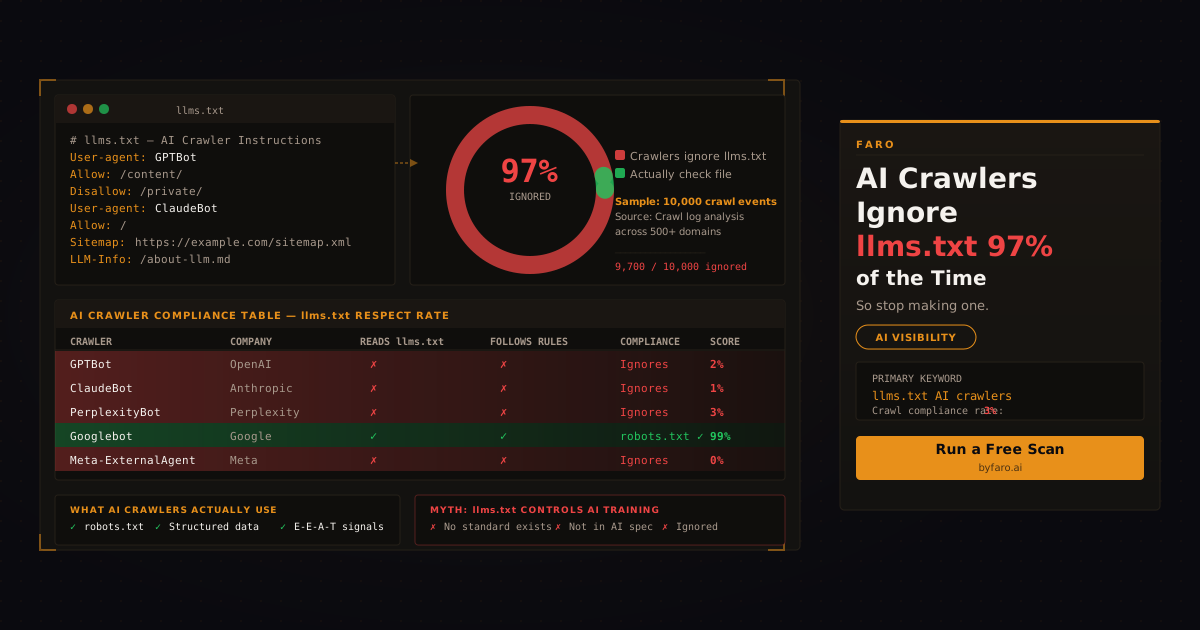
Ahrefs analyzed 137,210 live domains in May 2026 and found that 97% of llms.txt files received zero requests, from any bot, any human, anything. Not a single fetch. If you spent time creating one last quarter, you likely spent it on a file that no AI crawler ever opened. The relationship between llms.txt and AI crawlers that the SEO community hoped for simply does not exist in the data.
That finding is not a rounding error or a sampling artifact. It holds across tens of thousands of domains, and a separate 300,000-domain study reached the same conclusion from a different angle. Yet llms.txt implementation guides keep circulating, agencies keep billing for the work, and founders keep asking whether they need one. The answer right now is almost certainly no.
Here is why the file never delivered what its proponents promised, what AI bots are actually doing instead, and where to point your time and budget if AI citation visibility is the goal.
Key takeaways
- Ahrefs analyzed 137,210 live domains in May 2026 and found 97% of llms.txt files received zero requests.
- Of the requests that did arrive, AI retrieval bots linked to ChatGPT and Perplexity made up just 1%.
- Industry research across 300,000 domains found no statistically significant correlation between having an llms.txt file and AI citation frequency.
- OpenAI's crawler documentation tells you to manage GPTBot, OAI-SearchBot and ChatGPT-User through robots.txt, not llms.txt.
- Put your time into HTML structure, structured data, earned third-party mentions and measuring your current citation baseline.
What did the Ahrefs study actually find?
The numbers are more damning than the headline statistic suggests. Ahrefs found that of roughly 38,000 domains with a valid llms.txt file, only about 1,100 received any traffic to it in May 2026. That's a 97% failure rate on the basic premise that creating the file would invite AI crawlers to read it.
Of the 3% of files that did attract requests, the composition of those requests dismantles the narrative. According to Ahrefs' data, 96% of those requests came from bots, mostly non-AI ones; AI retrieval bots linked to ChatGPT and Perplexity made up just 1% of total requests. SEO audit tools accounted for 21% of requests. Unidentified bots accounted for 14%. Ahrefs' data shows Slackbot fetched llms.txt files more often than PerplexityBot did.
One more finding deserves attention: Ahrefs confirmed that AI bots never requested llms.txt on domains where the file did not already exist. Crawlers are not probing for it. They're not checking whether you have one. They don't care.
What are GPTBot and ClaudeBot actually crawling instead?
The bots crawl HTML the same way Google has for two decades. The growth numbers here are striking. From May 2024 to May 2025, GPTBot request volume grew 305% and overall AI-plus-search crawler traffic rose 18%, according to recent crawl traffic analysis. All of that growth happened against standard HTML pages.
Recent traffic analysis shows GPTBot's share of verified bot traffic grew from 4.7% in July 2024 to 11.7% in July 2025, while ClaudeBot grew from 6% to nearly 10% over the same period. Neither operator has documented their production systems as consuming llms.txt.
A recent year-in-review analysis of crawl traffic found crawling for model training reached as much as 7 to 8 times search crawling volume and 32 times user-action crawling at peak. That's an enormous amount of crawl activity, and it operates entirely on raw HTML.
The official documentation confirms this. OpenAI's crawler documentation covers GPTBot, OAI-SearchBot, and ChatGPT-User and instructs site owners to manage access via robots.txt. The llms.txt file isn't mentioned as a signal or a requirement anywhere in that documentation.
Does having an llms.txt file improve AI citation frequency?
No. Not in any study that has attempted to measure it. Industry research analyzing 300,000 domains found no statistically significant correlation between having an llms.txt file and AI citation frequency; removing the llms.txt variable from an XGBoost predictive model actually improved its accuracy. The variable was noise, not signal.
Even the file's adoption rate undercuts the narrative. Industry research crawling those 300,000 domains found llms.txt present on only 10.13% of them. Nearly 9 out of 10 sites had not implemented it, and those sites were being cited by AI tools at rates no different from those that had.
Faro's own scans point the same way: of the 2,335 sites in the Faro Registry with a result for this check (scanned August 2026 to October 2026), 29% publish an llms.txt file. That is higher than the 10.13% in the 300,000-domain study, and still a minority. The registry is the set of sites Faro has scanned, not a random sample of the web.
Google's guidance is equally direct. In a section titled "mythbusting" published in late May 2026, Google told site owners that machine-readable files like llms.txt are not needed to appear in generative AI search. Google's John Mueller described llms.txt as "not done for search" and called it "a temporary crutch, perhaps to save some tokens" for AI coding tools parsing developer documentation.
If you want to understand your actual AI visibility posture rather than guessing, Faro's AI Visibility Checker runs 38 checks across six categories and returns a scored view of what AI systems can and cannot read on your site today.
Wondering whether your content is actually reaching AI systems? Run a free AI visibility check and see exactly which signals are helping or hurting your AI citation chances.
How does llms.txt compare to signals that actually matter?
The table below maps the main levers marketers reach for when trying to improve AI visibility. It shows what the current evidence says about each one.
| Signal | What AI crawlers do with it | Evidence of citation lift | Who controls it |
|---|---|---|---|
| llms.txt file | 97% of the time: nothing | No measurable effect in two large studies | Site owner |
| robots.txt directives | GPTBot respects allow/disallow blocks | Controls access; documented by OpenAI | Site owner |
| Structured data / Schema markup | Parsed during HTML crawl | Strong signals for entity recognition | Site owner |
| Page HTML clarity and heading structure | Consumed directly by every major AI crawler | Core input to answer generation | Site owner |
| Third-party citations and mentions | Weighted heavily in training corpora | Consistent predictor of AI recommendation | Earned through PR, content, authority |
| Brand search volume | Indirect signal via indexed content about brand | AI-recommended brands are 389% more likely to be Googled after | Earned through awareness |
Why did llms.txt spread so fast if it does nothing?
The proposal had a credible origin story. Answer.AI and fast.ai published the llms.txt specification in late 2024, positioning it as a way for sites to surface clean, context-ready content for LLM consumption. The proposal on llmstxt.org is dated September 3, 2024. That framing resonated with SEOs trained to think in terms of structured signals: if Google needed sitemaps and schema, surely AI would need its own guidance file.
The logic was plausible. The problem is that it was never validated. No major AI lab adopted the spec in their documented crawler behavior. Traffic analysis across hundreds of millions of AI requests shows GPTBot, ClaudeBot, PerplexityBot, OAI-SearchBot, and Google-Extended overwhelmingly skip the llms.txt file and go straight to crawling HTML.
As of mid-2026, none of OpenAI, Google, Anthropic, Meta, Perplexity, or Mistral has publicly stated that their production systems read or act on llms.txt. The spec spread because it was easy to implement and satisfying to tick off a checklist. Neither of those is a good reason to prioritize it.
The robots.txt comparison reveals the deeper problem
robots.txt works because every major crawler has been programmed to read it, respect it, and alter behavior based on it. OpenAI says so explicitly in their crawler docs. Google has enforced it for decades. The compliance infrastructure exists.
llms.txt has no equivalent infrastructure. No crawler has committed to reading it. No enforcement mechanism exists. It's a file that site owners write, post publicly, and then wait, while bots that were never instructed to look for it continue crawling HTML as they always have. If you want to control what AI systems can see on your domain, your robots.txt configuration is the only file with actual teeth right now. Which of those rules actually bite, and which bots ignore them entirely, is broken down in robots.txt for AI crawlers: what actually blocks them.
What should you do instead of building an llms.txt file?
Focus on the same things that have always driven topical authority, with an AI-visibility lens applied to each one.
First, get your HTML structure right. AI crawlers parse the same heading hierarchy, body copy, and link signals that search crawlers do. Thin pages, buried context, and weak entity signals hurt you in both channels. Fix the underlying content quality before worrying about any auxiliary file.
Second, get your structured data right. Schema markup is consumed during the HTML crawl that AI bots are already performing. Entity clarity, FAQ schema, and organization markup all give AI systems cleaner inputs when they're deciding whether to cite or summarize your content. Faro's AI Schema Creator generates markup specifically optimized for the entity signals AI systems look for. If the appeal of llms.txt was one file describing your whole business, the OKF Generator does that in a structured format built to be parsed rather than hoped over.
Third, earn third-party mentions. Industry AEO research consistently identifies external citations as the strongest predictor of AI recommendation frequency. A brand mentioned in authoritative sources gets pulled into training data and retrieval contexts repeatedly. A brand with a polished llms.txt file and no external mentions gets ignored.
Fourth, measure what's actually happening. Most marketers building for AI visibility have no idea whether AI systems are citing them, how often, or in what contexts. That gap is worth closing before any implementation work begins.
Frequently Asked Questions
Will llms.txt ever start working as AI search matures?
It's possible but not guaranteed. No major AI lab has committed to supporting the spec, and the Ahrefs data from May 2026 shows adoption has not translated into crawler behavior. If OpenAI, Anthropic, or Google formally integrates llms.txt into their crawler documentation, the calculus changes. Until then, there's no evidence-based reason to prioritize it over HTML structure, schema, and earned mentions.
Does llms.txt hurt anything if I already have one?
No. A correctly formatted llms.txt file doesn't appear to penalize sites or misdirect crawlers. The cost is the opportunity cost: time spent creating and maintaining it that could go toward content quality, schema implementation, or citation-building. If you have one, keeping it live is fine. Building elaborate versions from scratch isn't worth the investment given current data.
What file actually controls whether GPTBot crawls my site?
robots.txt. OpenAI's official crawler documentation instructs site owners to use robots.txt disallow directives to block GPTBot, OAI-SearchBot, or ChatGPT-User. That's the documented, tested, and respected mechanism. llms.txt has no equivalent enforcement pathway with any major crawler operator.
If 9 out of 10 sites lack llms.txt and still get cited, what does predict AI citations?
Industry research found that topical authority signals, external mention frequency, and structured HTML clarity were stronger predictors than any auxiliary file. Brands with clear entity definitions, consistent mentions in authoritative sources, and clean content structure outperform in AI citation contexts regardless of whether they've implemented llms.txt.
Should agencies stop recommending llms.txt to clients entirely?
For most clients, yes. The implementation is low-cost but not zero-cost, and the evidence of benefit is nonexistent across two large studies. Agencies that position llms.txt as a meaningful AI visibility tactic are selling a ritual, not a result. Direct that effort toward schema audits, content clarity improvements, and citation monitoring instead.
In short
The data is unambiguous: 97% of llms.txt files received zero requests in the most comprehensive study ever run on the format. GPTBot, ClaudeBot, and every other major AI crawler crawl HTML directly and have no documented behavior tied to llms.txt. Two independent large-scale studies found no correlation between having the file and appearing in AI citations more frequently. The file spread because the logic sounded plausible and the implementation was easy, not because it worked. If AI visibility is a commercial priority for your brand, the levers are HTML structure, schema markup, earned third-party mentions, and knowing your current citation baseline. None of those require a llms.txt file.
Ready to find out what AI systems actually see when they crawl your site? Run a free AI visibility check and get a scored breakdown of the signals that move AI citation frequency, not the ones that just look good on a checklist.