Your clients are about to start getting questions they don't have answers to. "Why isn't our company appearing in ChatGPT recommendations?" "Are AI agents able to find our pricing?" "Is our website blocking AI crawlers?" Right now, most agencies don't have answers to these questions either. The ones that get there first will own a new service category for years.
AI visibility auditing is a natural extension of the services digital agencies already provide. Your clients already trust you with their SEO, their web presence, and their technical infrastructure. AI visibility sits in the same trust zone: it's a technical audit of how well their website performs for a new category of visitor. The difference is that most clients have no idea the problem exists, which makes the initial audit an easier conversation than most.
Why now?
AI agent usage is growing faster than business awareness of it. The gap between "AI agents are searching the web for products and services" and "businesses know they need to optimize for AI agents" is currently wide. Five years ago, that same gap existed for mobile optimization and local SEO. The agencies that moved early built practices that are still generating revenue.
The AI visibility audit category is early enough that there is no established competitive framework yet. Clients haven't been pitched by twenty agencies offering the same service. The vocabulary is still forming. An agency that positions clearly now, with a structured audit methodology and clear deliverables, can define the category for their clients rather than competing on price in an established market. That same absence of established playbooks is even more pronounced for early-stage startups, who often have the thinnest AI footprint of any client segment and the fastest wins to show once it's fixed.
What does an AI visibility audit include?
A well-structured AI visibility audit covers six dimensions, each representing a different way that AI agents evaluate and interact with a client's website. These are the same dimensions Faro's scan measures:
- AI discoverability: Does the site have llms.txt? Is the sitemap current? Is content structured for agent comprehension?
- Structured data: Is there JSON-LD schema markup? Which types are present and which are missing? Is it server-rendered?
- Pricing transparency: Is pricing server-rendered? Are plan names and limits labeled clearly? Is there a purchase path an agent can follow?
- API readiness: Is there a public API? Is it documented? Is there an OpenAPI spec?
- Documentation quality: Is documentation crawlable and well-structured? Does it give agents enough context to form confident recommendations?
- Agent access: Does robots.txt allow AI crawlers? Are there JavaScript-only content barriers? Is the site accessible without client-side rendering?
The output of a professional audit is a scored assessment across these dimensions, a prioritized fix list, and a roadmap for implementation. If you are building out the client-facing reporting side of that engagement, the Search Console AI Overview section helps but does not cover the full picture clients will ask about. For agencies, the audit creates the engagement; the implementation is the ongoing work.
White-label AI visibility audits for your agency
Run unlimited client scans. Faro's API makes it easy.
How to package and price AI visibility audits
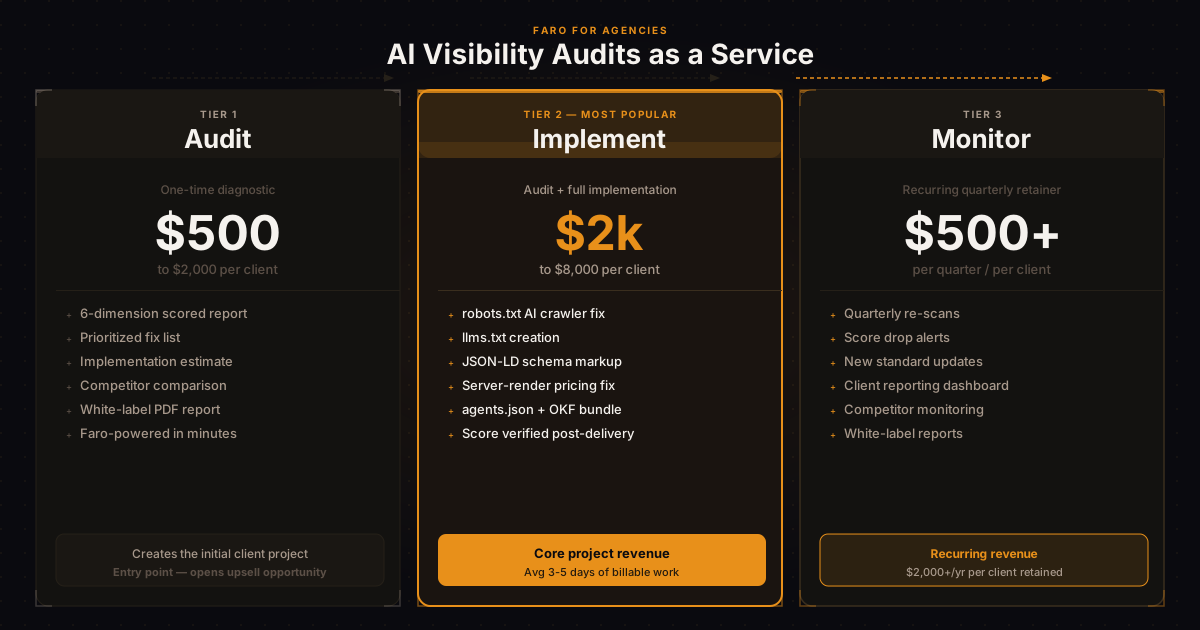
There are three natural service tiers that most agencies settle on when building this practice.
The entry point is a one-time AI visibility audit delivered as a report. This is the "diagnostic" product: a scored assessment of the client's current AI visibility, a priority list of fixes, and an implementation estimate. Typical pricing for this tier sits between $500 and $2,000 depending on site complexity and your market positioning. The purpose of this product is to surface the opportunity and create the implementation engagement.
The mid-tier is an audit plus implementation: the agency runs the audit, identifies the fixes, and then delivers them. This is where most of the revenue sits. A typical implementation project covers the high-impact fixes: robots.txt corrections, llms.txt creation, JSON-LD schema markup, and server-side rendering for critical pages. Project value is typically $2,000 to $8,000 depending on scope.
The recurring tier is AI visibility monitoring: quarterly re-scans, alerts when AI visibility drops (for example, after a site update breaks server-side rendering), and ongoing optimization as new AI crawlers and standards emerge. This is the highest-value product because it's predictable revenue and directly tied to a measurable outcome the client cares about.
Which clients should you approach first?
The most receptive early clients are typically those who already have some AI awareness: they've experimented with ChatGPT, they've read about AI agents, and they have a marketing or SEO team that thinks about channel diversification. These clients don't need to be educated on why AI discovery matters; they just need a structured way to think about and measure it. Healthcare providers fit this pattern well: patients are starting to ask AI assistants to compare providers and confirm insurance acceptance, and most healthcare websites are not structured to answer those questions accurately.
B2B SaaS clients are particularly strong candidates because they're the most exposed to AI agent purchasing behavior. When a procurement agent evaluates project management software, CRMs, or analytics tools for a company, it's doing exactly the kind of comparison that rewards AI visibility. A B2B SaaS client with poor AI visibility may already be losing evaluation cycles to competitors without knowing it.
Professional services firms, law firms, consultancies, and financial services businesses are another strong segment: they have high transaction values, sophisticated buyers who may be using AI for vendor evaluation, and marketing teams that are already used to technical optimization conversations. The same logic applies to law firms specifically, where agents summarizing case outcomes and jurisdiction details need accurate, citable source pages rather than marketing copy. Real estate brokerages face a related but distinct problem: listing and pricing data changes daily and is rarely structured in a way agents can parse reliably.
Using Faro to run client audits
Faro is built with agency use cases in mind. The AI Visibility Checker can be run on any publicly accessible URL, which means you can audit client sites (and competitor sites for comparison) in 30 seconds each. The output gives you a scored report across six dimensions with a prioritized fix list that maps directly to billable implementation work. The same checks apply to your own agency's site, and why ChatGPT or Gemini may not recommend your marketing agency covers the gaps that keep agency sites off AI shortlists.
Agency plans include automated monitoring for clients on retainer, with API access for programmatic bulk scanning coming soon. The Faro agency overview has more detail on how agencies are using the platform for client delivery.
In short
AI visibility auditing is a natural agency service extension with low awareness among clients and significant room for early movers to establish expertise. The three-tier model of audit, implement, and monitor creates a clear path from first engagement to recurring revenue. B2B SaaS, professional services, and technically sophisticated marketers are the most receptive early clients. The category is early enough that positioning now means defining the conversation rather than entering an established competitive market.
Frequently asked questions
Do I need technical staff to deliver AI visibility audits?
Not for the audit itself. Running a scan and interpreting the results requires understanding of the six dimensions but not deep technical expertise. Implementation, particularly server-side rendering fixes and JSON-LD schema markup, does require someone with web development knowledge. Most agencies partner the audit delivery with their existing technical team.
How do I justify AI visibility to a skeptical client?
Ask them to search their category in ChatGPT, Claude, or Perplexity and check whether their business appears. For most businesses, the answer is no, or they appear with incomplete or inaccurate information. That demonstration creates more urgency than any explanation.
Can AI visibility audits be white-labeled?
Yes. White-label PDF reports are included in the Agency plan today, and API access for programmatic scanning is coming soon. Many agencies present results in their own reporting format with their own visual identity. Visit the agency overview to learn more about partnership options and Agency plan pricing.
What makes AI visibility different from a technical SEO audit?
A technical SEO audit focuses on signals that affect search engine rankings: page speed, crawl errors, link structure, canonicalization. An AI visibility audit focuses on signals that affect AI agent evaluation: structured data completeness, pricing accessibility, API documentation, llms.txt, and AI crawler access. Some items appear in both; most AI visibility items are new work.
Start by running the Faro AI Visibility Checker on three of your existing clients' websites. You'll have concrete data to start the conversation with in under two minutes. For agency-specific pricing, visit the agency overview for plan details.
The full AI SEO tools suite is available to all agency accounts — use every tool across your client portfolio from a single workspace.